
Barn Beam Mantel vs Sawn Beam Mantel: Which Is Right?
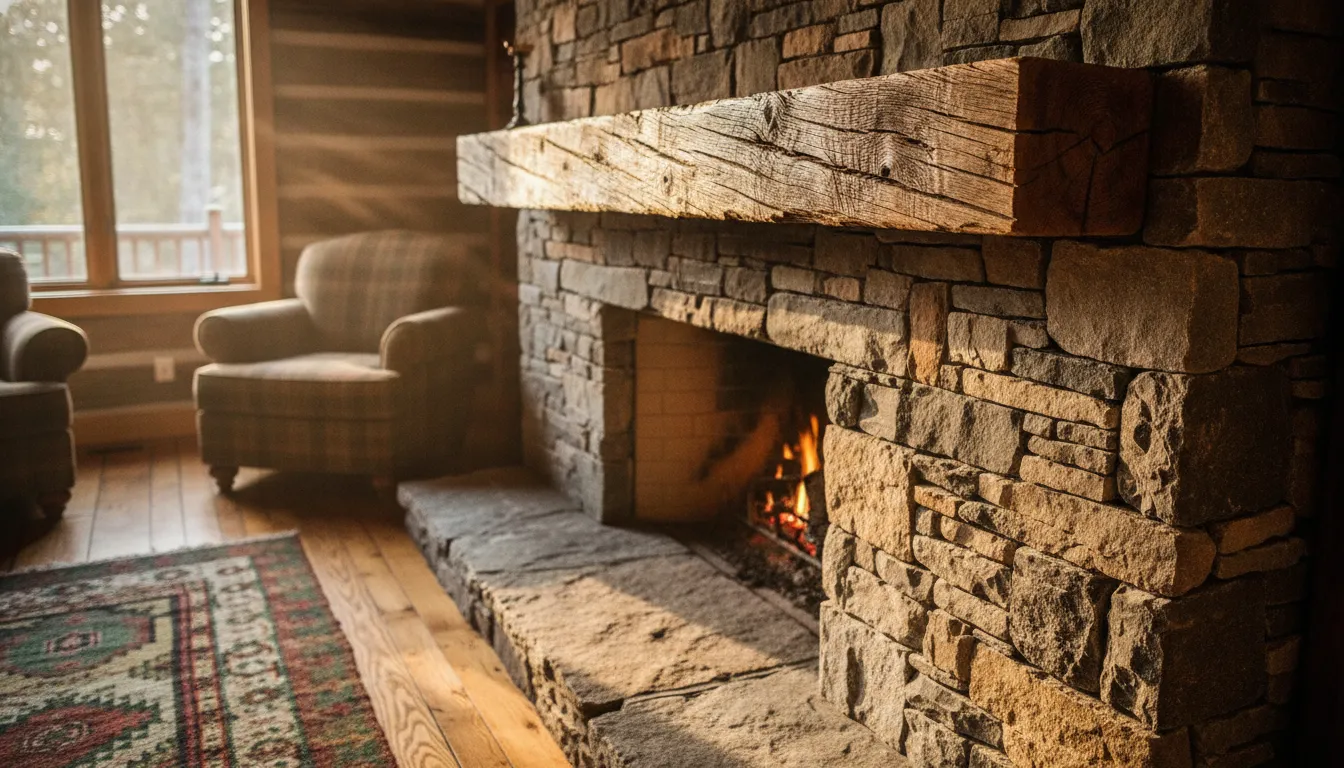
A fireplace mantel does more than finish a surround. Its surface, edge profile, and visible history can determine whether the room feels rooted in an agricultural past or deliberately refined. The right choice begins with the character you want the beam to carry, not simply the dimensions available.
Request a quote for a custom mantel beam
A barn beam mantel vs sawn beam mantel comparison comes down to texture and design intent: hand-hewn barn beams show irregular tool marks. Checking, wane, and other signs of use, while sawn beams offer a more consistent surface suited to modern or transitional interiors. Both are custom-sourced and can be finished and sized to fit the surround.
Reclaimed material brings more than visual texture. Properly selected and processed, it retains the provenance of hundreds of years of use while being prepared for a demanding architectural application. For broader guidance on dimensions, sourcing, and reclaimed-beam specifications, see our reclaimed wood beams guide. The sections below clarify how each beam style changes the character of a fireplace surround so you can specify the right mantel for your project.
Barn Beam Mantel vs Sawn Beam Mantel Comes Down to Texture and Design Intent
For a fireplace surround, the distinction between a hand-hewn barn beam and a sawn beam is not simply rustic versus modern. It is a specification decision about how visibly the material records its making and its history. Hand-hewn surfaces carry irregular tool marks and a more animated profile. Sawn surfaces establish a controlled field of grain and kerf, giving the mantel a quieter, more consistent presence.
| Characteristic | Barn-beam mantel, hand-hewn | Sawn beam mantel |
|---|---|---|
| Surface texture | Irregular, tactile, and visibly shaped by hand tools, with a varied plane across the face. | More uniform and controlled, with a consistent rough-sawn or dressed texture across the beam. |
| Tool marks | Distinct adze or broad-axe marks can remain legible, creating a direct connection to historic barn construction. | Saw kerf or a cleanly milled surface produces a regular visual rhythm rather than individual hewing marks. |
| Pattern consistency | Every face is more individual. Checking, knots, wane, and historic marks may shift noticeably from one end to the other. | Grain direction and surface treatment read more predictably, making alignment with adjacent finishes easier. |
| Material feel | Heavy, weathered, and deeply patinated, with natural irregularity treated as part of the material's identity. | Substantial and authentic, but visually calmer, especially when lightly sanded or finished to accentuate the grain. |
| Best-fit design style | Historic restorations, agricultural structures, rustic renovations, and interiors where provenance is a focal point. | Modern farmhouse, transitional, contemporary, and refined interiors that need reclaimed character with tighter visual control. |
Those distinctions matter at architectural scale. A hand-hewn mantel can become the visual anchor in a room with plaster, fieldstone, wide-plank flooring, or other materials that benefit from an irregular edge. Its checking and wane should be reviewed as part of the elevation, not treated as defects to be hidden. Checking is a natural result of moisture loss in wood, and authentic reclaimed material commonly retains this type of surface evidence.
A sawn mantel is often the better fit when the fireplace must sit comfortably among clean millwork, flush wall planes, or repeated modern lines. Its consistency does not make it less authentic. It simply shifts emphasis from tool history to grain, proportion, and finish. Light sanding or a clear coat can clarify the wood without erasing its reclaimed character.
For project teams documenting species, dimensions, visible faces, and acceptable degrees of checking or wane, our reclaimed wood beams specification and sourcing guide provides useful starting points. The final selection should be based on the room's material palette and the level of irregularity the design can intentionally support.
Rough-Hewn Barn Beams: Character, Marks, and the Agricultural Story
A rough-hewn barn beam carries evidence of how it was made, used, and recovered. Its broad faces may show irregular adze or axe cuts rather than a consistent saw kerf. These hand-tool marks are associated with early American building practices, when settlers shaped structural timbers with traditional tools. The result is not a manufactured texture applied for effect. It is the working surface of a beam that served a purpose before becoming a fireplace mantel.
For architects, builders, and designers, the distinction matters. A hand-hewn face has changing planes, shallow facets, and localized variation in relief. Light moves across those surfaces differently throughout the day, giving the mantel a tactile, materially specific presence. The profile may remain generally square, but the arrises can be softened, and the visible faces may not read as perfectly uniform from one end to the other. That irregularity is central to the specification, not an incidental flaw.
Checking, wane, and other signs of authentic material
Reclaimed wood commonly retains checking, wane, knots, and historic marks. Checking consists of longitudinal splits that develop as wood responds to changes in moisture. Wane is the absence of wood along an edge, often reflecting the original curvature of the tree. In a rough-hewn mantel, these features contribute to the agricultural character and help distinguish salvaged material from newly milled stock. They should be evaluated for location, depth, stability, and suitability for the installation, but they should not automatically be treated as defects.
Surface character also records the beam's working environment. Abrasion, darkened grain, nail staining, and patina can indicate years of service in a historic barn or other agricultural structure. Each recovered timber has a different balance of these features, so a sample or individual beam review is valuable when a project requires a controlled visual match. Wood Crafting custom-sources beams from salvaged buildings and processes them according to the intended material expression.
Processing without erasing provenance
Wood Crafting offers three processing levels: As-Is, De-nailed, and Power Washed. As-Is preserves the greatest amount of surface evidence for a deliberately raw specification. De-nailed removes embedded fasteners while retaining much of the beam's patina and tool work. Power Washed reduces loose dirt and surface residue for projects requiring a cleaner starting point. The appropriate level depends on the design intent, handling requirements, and desired finish, not on a universal definition of reclaimed quality.
Before selecting a mantel, review how to choose a reclaimed wood fireplace mantel beam and document the preferred amount of checking, wane, tool marking, and surface cleaning in the specification.
Clean-Sawn Reclaimed Beams: A More Refined Reclaimed Look
Clean-sawn reclaimed beams suit projects that need the provenance of old timber without the irregular relief of a hand-hewn surface. A consistent saw kerf creates a more even plane and a repeatable visual pattern. Making the beam easier to coordinate with precise millwork, crisp wall finishes, and contemporary fireplace detailing. The result is refined, but it is not new-looking: reclaimed grain, checking, knots, and patina remain visible.
Compared with a hand-hewn barn beam, a clean-sawn member has less variation from one face to the next. Hand-hewn beams carry broad adze or axe marks, softened edges, and localized changes in profile that make each piece highly individual. Sawn beams instead present a controlled surface texture. That distinction matters when a mantel is intended to read as a deliberate architectural element rather than as a visibly rugged artifact.
Uniform kerf, controlled surface character
The saw pattern can be rough enough to retain tactile depth or refined through additional processing, depending on the specification. Because the kerf is more uniform, designers can align the beam with adjacent casing, stone, plaster, or built-in cabinetry without introducing competing surface movement. This consistency is often a better fit for modern and transitional interiors, where the reclaimed material is expected to provide warmth while the overall composition remains disciplined.
Clean-sawn does not mean character-free. Salvaged timber still records its previous service through grain direction, nail pockets, mineral streaking, knots, checking, and areas of wane. Those marks provide material evidence and visual variation within the more orderly saw texture. Checking is a natural result of moisture movement in wood, not automatically a defect. So it should be evaluated as part of the beam's condition and intended appearance rather than removed indiscriminately.
Finishing a clean-sawn beam mantel
Finishing can push the material toward either a quieter or more expressive result. Light sanding reduces loose fibers and sharp transitions while preserving the saw character. A stain can deepen contrast between earlywood and latewood, while a clear coat protects the surface and lets the reclaimed grain remain the primary visual feature. On a clean-sawn beam, these treatments can accentuate the grain, knots, and historic marks without relying on heavy distressing.
Specify the finish alongside the surface treatment, not as an afterthought. A natural finish may preserve the pale, architectural quality of the sawn face. A warmer stain can connect the mantel to flooring or cabinetry. For project budgeting and scope decisions, review reclaimed wood beam costs and pricing before finalizing the beam dimensions, processing level, and finish schedule.
Which Style Suits Your Fireplace Surround and Room Design?
Choose a barn beam mantel when the room depends on visible history, irregular texture, and a strong rustic or country focal point. Choose a sawn beam mantel when the design calls for cleaner lines, controlled proportions, and a more modern or transitional farmhouse expression. The fireplace surround, ceiling height, and overall room scale should determine which profile feels intentional rather than simply decorative.
- Traditional, rustic, or country rooms: A barn beam mantel with hand-hewn tool marks, checking, wane, knots, and other historic marks reinforces a surround built from fieldstone, rough brick, or irregular natural materials. Its surface variation gives the fireplace the visual weight expected in a lodge, farmhouse, or historically informed renovation.
- Modern or transitional farmhouse rooms: A sawn beam offers a more consistent face and a quieter visual field. It pairs effectively with honed stone, restrained brick, large-format tile, or a painted surround where the mantel should introduce warmth without competing with the finish palette.
- Tall ceilings and large rooms: A substantial solid barn beam can anchor the vertical volume and read as an architectural element. Confirm the beam's actual depth and projection against the fireplace opening, adjacent millwork, and sightlines across the room.
- Lower ceilings or compact rooms: A cleaner sawn profile can preserve visual order and reduce the sense of mass. A solid reclaimed beam still provides authentic weight and character, but its dimensions should be scaled carefully so the surround remains the focal point without overwhelming the room.
- Highly textured surrounds: When the stone or brick already carries pronounced variation, a sawn face may create useful contrast and clarify the mantel's edge. Conversely, a smoother tile surround can benefit from the patina and irregularity of a barn beam.
Coordinate the mantel with the whole material palette
For custom home builders and architects, the decision is also a specification question. Review the mantel alongside flooring, ceiling beams, trim profiles, cabinetry, and the intended degree of historical authenticity. Reclaimed wood from salvaged buildings retains the provenance and material character of years of use. So a barn beam can become a meaningful centerpiece in a rustic architectural renovation. A sawn beam is often the better bridge between reclaimed material and a disciplined contemporary interior.
Do not treat the choice as a finish-only decision. Solid beam mantels carry substantial weight and require a mounting approach coordinated with wall structure and fireplace clearances. Share the opening dimensions, desired projection, ceiling height, surround material, and design references during specification so the beam can be evaluated for both proportion and installation requirements.
Availability, Lead Times, and Custom Sizing for Beam Mantels
A reclaimed beam mantel is specified around the fireplace and the material, not selected from a standard stock list. Wood Crafting custom-sources solid beams from salvaged buildings, so the available section, species, patina, and surface character depend on the building material identified for the project. That sourcing model preserves provenance, but it also means timing must be evaluated with the quote rather than assumed from a retail catalog.
Start with the finished mantel length, required projection, visible height, and the fireplace opening dimensions. Most beam mantels are square or rectangular in section, but the beam can often be custom-cut to suit the fireplace length and the design intent. A builder or designer should also identify whether the installation calls for a solid structural-looking member, a specific amount of wane, or a controlled profile at the ends. Those details affect which salvaged beam section is appropriate and how much material can be retained during fabrication.
Choose the processing level before fabrication
Processing is another part of the specification. Wood Crafting offers three levels: As-Is, De-nailed, and Power Washed. As-Is retains the greatest amount of the beam's existing surface character and is appropriate when tool marks. Checking, old saw texture, and accumulated patina are central to the design. De-nailed removes embedded fasteners and other metal hazards while preserving much of the visual history. Power Washed provides a more thoroughly cleaned surface when the project requires a cleaner presentation, while still maintaining the character of reclaimed material.
Why lead times vary
Lead time varies because these mantels are custom-quoted rather than standard stock items. The sourcing batch may need to be matched to the required species, section size, length, and degree of weathering. A large, straight beam with enough sound material for a deep mantel may require a different search than a smaller member intended for a lighter surround. Processing, checking, de-nailing, washing, cutting, and any additional finishing also add project-specific steps. Reclaimed wood is a sustainable building material because it repurposes salvaged material, but responsible reuse requires selecting the right existing beam rather than forcing a poor fit.
For accurate timing, submit the fireplace dimensions, desired finished size, processing level, installation schedule, and reference images with your request. The resulting project quote can confirm what material is suitable and provide a realistic lead-time range based on the current sourcing batch.
Get a quote for your reclaimed beam mantel project.
How Do You Finish and Maintain a Reclaimed Beam Mantel?
Finishing a reclaimed beam mantel is a balance between protection and restraint. The objective is not to erase the material's history, but to stabilize the surface and make its existing character work with the room. Reclaimed wood may show checking, wane, knots, nail marks, and other evidence of its previous use. Checking, in particular, is a natural result of moisture loss and should not automatically be treated as a defect.
Before selecting a coating, determine whether the design calls for an As-Is surface, a lightly refined finish, or a more consistent appearance. Wood Crafting offers As-Is, De-nailed, and Power Washed processing levels, allowing the treatment plan to begin with the appropriate surface condition. Because each beam is custom-sourced and quote-based rather than a standard stock item, finish expectations should be included in the project specification and reviewed before fabrication.
Finishing options for reclaimed beam mantels
- Natural or clear coat: A low-sheen clear finish protects the surface while keeping the original patina, saw marks, checking, and tonal variation visible. This is often the right approach when provenance and material authenticity are the primary design goals.
- Light stain: A transparent or lightly pigmented stain can warm the beam, deepen contrast, and bring out grain without making the surface look newly manufactured.
- Dark stain: A deeper treatment can integrate the mantel with dark flooring, cabinetry, or trim. Test it on a representative section first, since knots, end grain, and weathered areas absorb pigment differently.
- Custom color treatment: A blended stain or compatible finish can coordinate the mantel with existing decor while preserving selected historic marks. The specification should identify which irregularities remain visible.
How much should the beam be sanded?
Sanding should be selective. A full aggressive sanding can flatten hand-hewn tool marks, soften crisp wane, and remove the surface variation that distinguishes reclaimed material from new-cut lumber. Light sanding may be appropriate for removing loose fibers, preparing a stable coating surface, or improving touch safety at frequently handled edges. Preserve sound checking and character marks unless they are loose, sharp, or structurally concerning. A finish can accentuate grain, knots, and historic marks, but it should not be used to disguise unstable wood.
Maintaining the mantel over time
Dust the surface with a soft, dry cloth and use only a manufacturer-approved cleaner for the selected coating. Avoid saturating the beam or introducing harsh solvents that could alter patina or sheen. Most importantly, keep indoor humidity reasonably controlled. Wood maintains its structural integrity best in an environment with controlled humidity, which helps limit the movement that can enlarge checks or stress a finish. Seasonal monitoring is especially important near fireplaces, where heat can dry the surrounding air. If a check opens noticeably, a finish flakes, or a section becomes loose, have the mantel evaluated rather than filling or sealing it as a cosmetic repair.
Frequently Asked Questions
What is the difference between a hand-hewn and sawn barn beam mantel?
A hand-hewn mantel shows irregular tool marks, uneven planes, and a stronger connection to historic barn construction. A sawn mantel has a more consistent surface, often with visible saw kerfs and cleaner geometry. Choose hand-hewn for pronounced age and character; choose sawn for a more controlled modern or transitional finish.
Should I choose a solid reclaimed barn beam or a hollow box beam mantel?
A solid beam provides substantial weight, depth, and authentic material character. A hollow box beam is lighter and can offer more installation precision, which may simplify some wall conditions. The choice depends on the desired visual mass, the wall structure, and how the mantel will be supported.
How do you mount a barn beam mantel?
Mounting typically uses a concealed support system, such as mounting sleeves or a ledger secured with lag bolts into the wall structure. The installer should verify the wall's load capacity, center the mantel, and maintain the required clearance from the fireplace opening under applicable local fire codes.
Are barn beam mantels always square?
No. A mantel can be specified with square, eased, or naturally irregular edges, depending on the beam and the design intent. Length, depth, height, end treatment, and the amount of wane can be custom-cut or selected to suit the fireplace surround and surrounding finish materials.
Can I finish a reclaimed barn wood mantel to match my decor?
Yes. Reclaimed wood can remain natural, receive selective sanding, or be treated with a stain or clear coat. Finish selection should account for the existing patina, checking, knots, and grain, since a coating can either preserve those features or make them more visually prominent.
Get a Quote for Your Reclaimed Beam Mantel
The right mantel profile depends on your fireplace dimensions, desired texture, mounting approach, and the room's design language. A project-specific review can clarify whether a barn beam or sawn beam will deliver the intended surround without compromising practical requirements such as wall capacity. Clearance, and finish expectations. Shared specifications, reference images, and schedule details help the team source the correct salvaged beam and provide a realistic lead-time range for your build.
Request a quote for your reclaimed beam mantel project and share your surround dimensions, finish preferences, and desired beam section so the team can evaluate the fit and confirm sourcing and timing.